The Floating World #2: The first Red Fuji was pink
A personal story, Asian Art in London, First Community Members Gallery.
蝸牛 そろそろ登れ 富士の山
Katatsumuri / sorosoro nobore / Fuji no yama
"Easy now, snail, / one slow step at a time / up Mount Fuji."
Kobayashi Issa (1763 to 1828) wrote this in Hokusai's lifetime, about the same mountain we look at today. Consider it permission to read this issue at a snail's pace.
Word of the Week: 鰯雲 (iwashigumo)
Literally "sardine clouds": the small, rippled high clouds that English speakers call a mackerel sky. In haiku it is an autumn season word. You will find a whole shoal of them in this week's masterpiece.
From the Studio
Last Sunday the very first issue of The Floating World landed in your inbox, and I was honestly surprised by how many of you signed up. I am so grateful. Thank you for reading, and for writing back. I read every reply, and we will keep working to make this the best newsletter it can be, for every one of you.
This week the old Japanese calendar moved into Shimo hajimete furu, "first frost": the five days when frost first settles on the grass. Here in the Netherlands frost was not quite what arrived: on Friday Storm Austen swept in with heavy rain and strong winds. A good weekend to stay inside with a cup of tea and some prints.
Personal Story
I have had a feeling for art my whole life. I loved drawing as a kid, and in high school I enjoyed art class, with a bit of art history on the side. But it never went much further than the odd museum visit, and only when I could find someone to come along. People who share that passion are hard to find in a small Dutch village, it feels more like something you find in the cities.
My first real contact with Japanese art was a random scroll on the internet. Somehow I ended up on the Wikipedia page of Kawase Hasui, and I loved his work instantly. Road to Nikkō, his forest print, has been my favourite artwork ever since. Soon after, I started an Instagram page to share Hasui's work, posting almost every day. That was right around the time Reels took off, and once I started making them, the page went viral several times and grew into what JPN Studio is today.
I am still on that journey. I learn and discover something new about Japanese art every day, and I hope to share all of it with you. My dream is to turn JPN Studio into a worldwide community of people who love this art as much as I do, and to work with museums and other institutions to give Japanese art, and the people behind it, the spotlight they deserve.
This week, that journey brings us to Hokusai's Red Fuji: a print everyone calls red, even though the earliest impressions were closer to pink.
On Friday you also received a free taste of our first Members' Letter, the start of a year on the Tōkaidō Road with Hiroshige. More on where that road goes next, below.
Hit reply and tell me: what was the first Japanese artwork that stopped you in your tracks, and how did you find it? Mine was Kawase Hasui, found on a random scroll through the internet. I would love to hear yours.
Bjorn
The Masterpiece: Katsushika Hokusai, Red Fuji, about 1830 to 1832
At a glance: Katsushika Hokusai (1760 to 1849) | 凱風快晴 Gaifū kaisei, "South Wind, Clear Sky", better known as Red Fuji (Akafuji) | from the series Thirty-six Views of Mount Fuji (冨嶽三十六景 Fugaku sanjūrokkei) | colour woodblock print, about 25 x 38 cm | publisher Nishimuraya Yohachi (Eijudō) | impression shown: The Metropolitan Museum of Art, New York
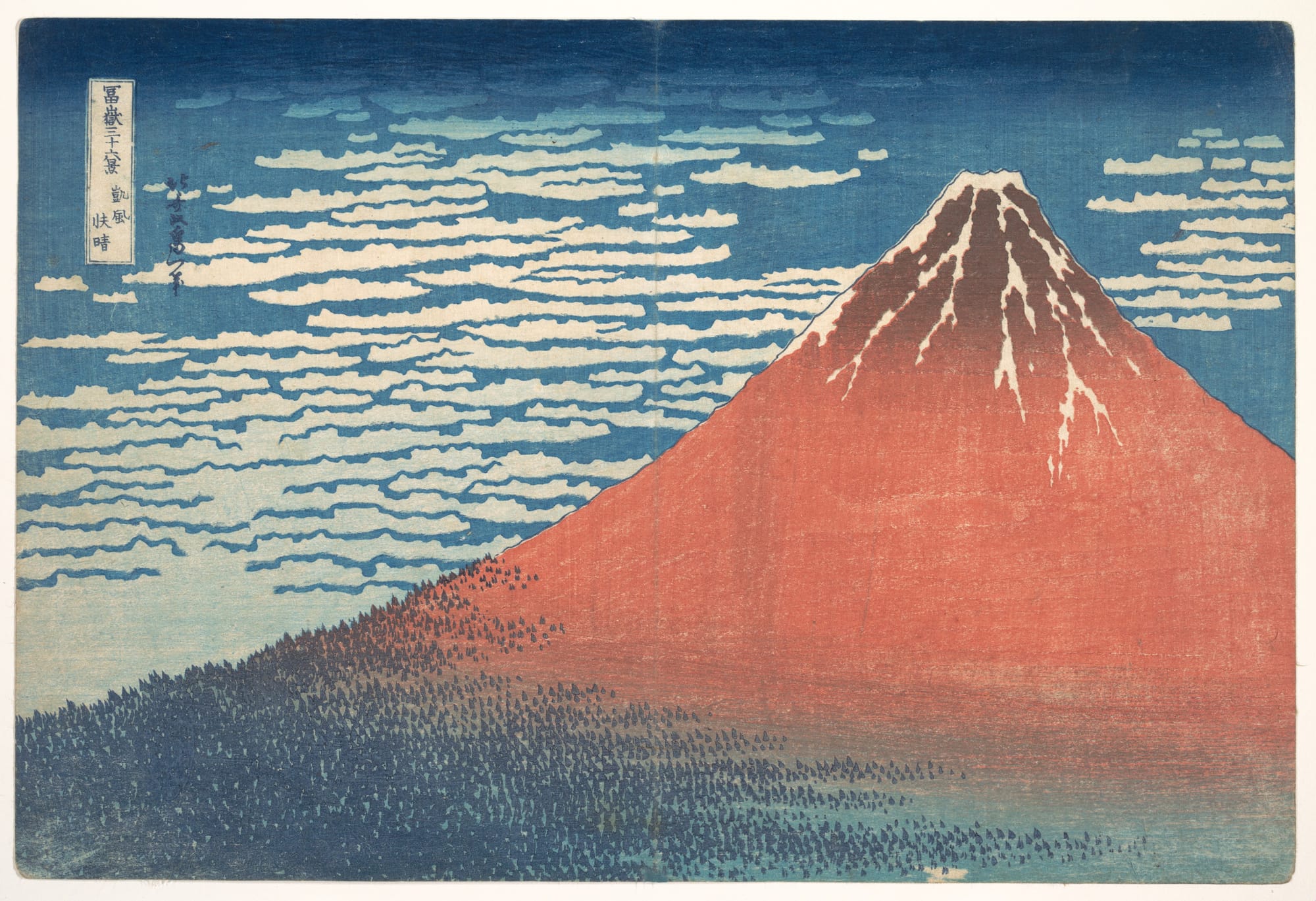
First look. Start at the summit, where the clouds part to form a halo and the last streaks of snow run down the rock. Now let your eye slide down the slopes. The bare upper mountain catches the first sun, while everything below the tree line is still in shadow. At the very bottom, the forest is nothing more than a row of tiny green triangles. There are no travellers, no boats, no houses. In a series full of everyday life, here the mountain has the page to itself.
The story behind it. Hokusai was around 70 when his publisher announced a new set of Fuji views at the start of 1831. The series made landscape a major subject for Japanese prints, and it was the first to use the imported pigment Prussian blue on a large scale. It sold so well that ten more designs were added, for 46 in total.
The title is a weather report. It is said that in late summer or early autumn, with a southern breeze and a clear sky, the rising sun can turn Fuji's slopes red. We are looking at the eastern face of the mountain, at the moment the first rays arrive from over the Pacific.
Three details you might miss
- The sardine clouds. That dappled sky is iwashigumo, our word of the week. In early impressions the printer inked the pale blue unevenly on purpose, so the morning looks bright and the clouds seem to drift.
- A flaw in the wood. Look straight down from the summit to the bottom edge of the green. The British Museum notes a small white flaw in the green block that turns up in every impression. Nearly 200 years on, that tiny mark is still the block's fingerprint.
- A changed name. The signature reads Hokusai aratame Iitsu hitsu: "brushed by Iitsu, formerly Hokusai". He used more than one name in his long career, and in these years he signed as Iitsu.
Why it still matters. Red Fuji and the Great Wave are probably the two most recognised pieces of Japanese art in the world. Yet the name is modern. The earliest impressions show a soft, pinkish-brown mountain, the bold red came with later printings, and that is the version the world remembers.
For Members This Week
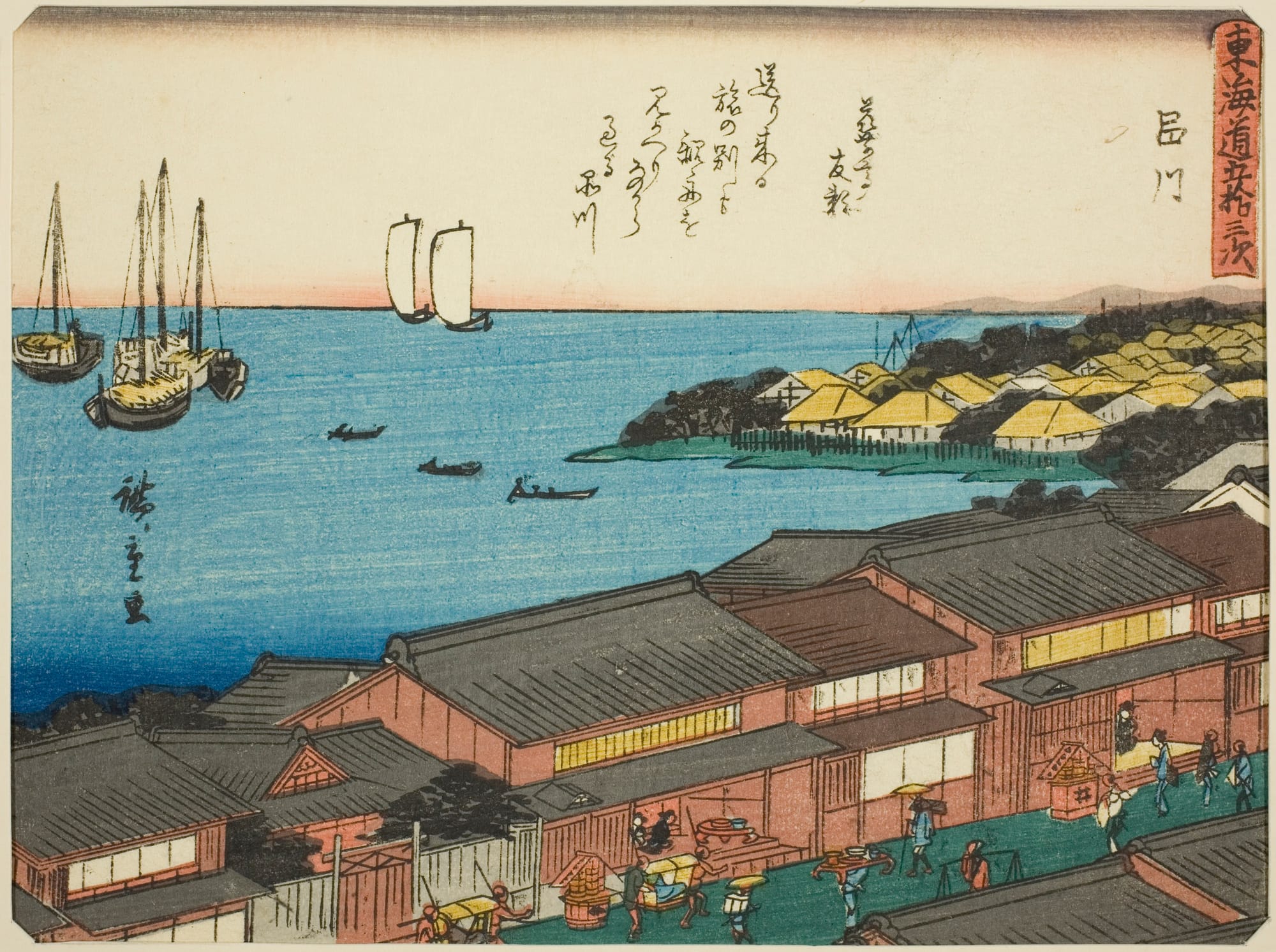
We left Nihonbashi before dawn, a few steps behind a lord's procession. This Friday we reach Shinagawa, the first station on the road, and for the first time Hiroshige shows us the sea. The procession is still there, but now we only see its tail end, disappearing down the road. Where is it heading?
Worth the Journey
Asian Art in London, venues across central London | 29 October to 10 November 2026
From this Thursday, London turns into one big Asian art season. Specialist dealers open exhibitions within walking distance of each other, the major auction houses hold their Asian art sales, and there are talks all week. Works of art from Japan are part of the mix, so it is the best week of the year to see pieces up close before they go under the hammer. Programme and guidebook
Good to know: the evening openings are the easiest way in. South Kensington and Belgravia on Saturday 31 October, St James's on Sunday 1 November, and Mayfair on Monday 2 November.
Also on
- New York: Manga Before Manga: Japanese Art from the Collection, Brooklyn Museum, until 31 January 2027. Twenty-one works trace the roots of manga, including 19th-century printed sketchbooks.
- Nagoya: Allure of Japan and the Dawn of Modern Japanese Painting: 100 Years After William Bigelow's Death, Aichi Prefectural Museum of Art, 30 October to 13 December 2026.
- Hong Kong: Myths and Monsters: The Art of Fantasy in Asia, M+, until 4 April 2027. More than 400 works follow 200 years of fantasy in Asian visual culture, from ukiyo-e woodblock prints to manga and anime.
The Collector's Corner: Collector's Notes
Early or late? How to read a Red Fuji
Edo publishers kept printing from the same blocks for as long as people kept buying, so hundreds of impressions of Hokusai's most popular Fuji views survive. That is why two Red Fujis can look, and sell, very differently. Using the British Museum's notes, here is what to look at:
- The mountain: the earliest impressions are a soft pinkish-brown. The strong red, often with a darker blue sky, belongs to later printings.
- The line of light: early on, the border between red and green curves around the cone. Later printers simplified it to a straight diagonal, which was quicker to print.
- The forest: the earliest impressions also show a large expanse of green at the foot of the mountain.
The collector's lesson: a late, bright red impression is not a fake, but it is a different object from an early pink one. Ask which printing you are looking at, and compare it with museum examples online before you buy.
Own a print or thinking of buying one? Hit reply.
Spot the Detail
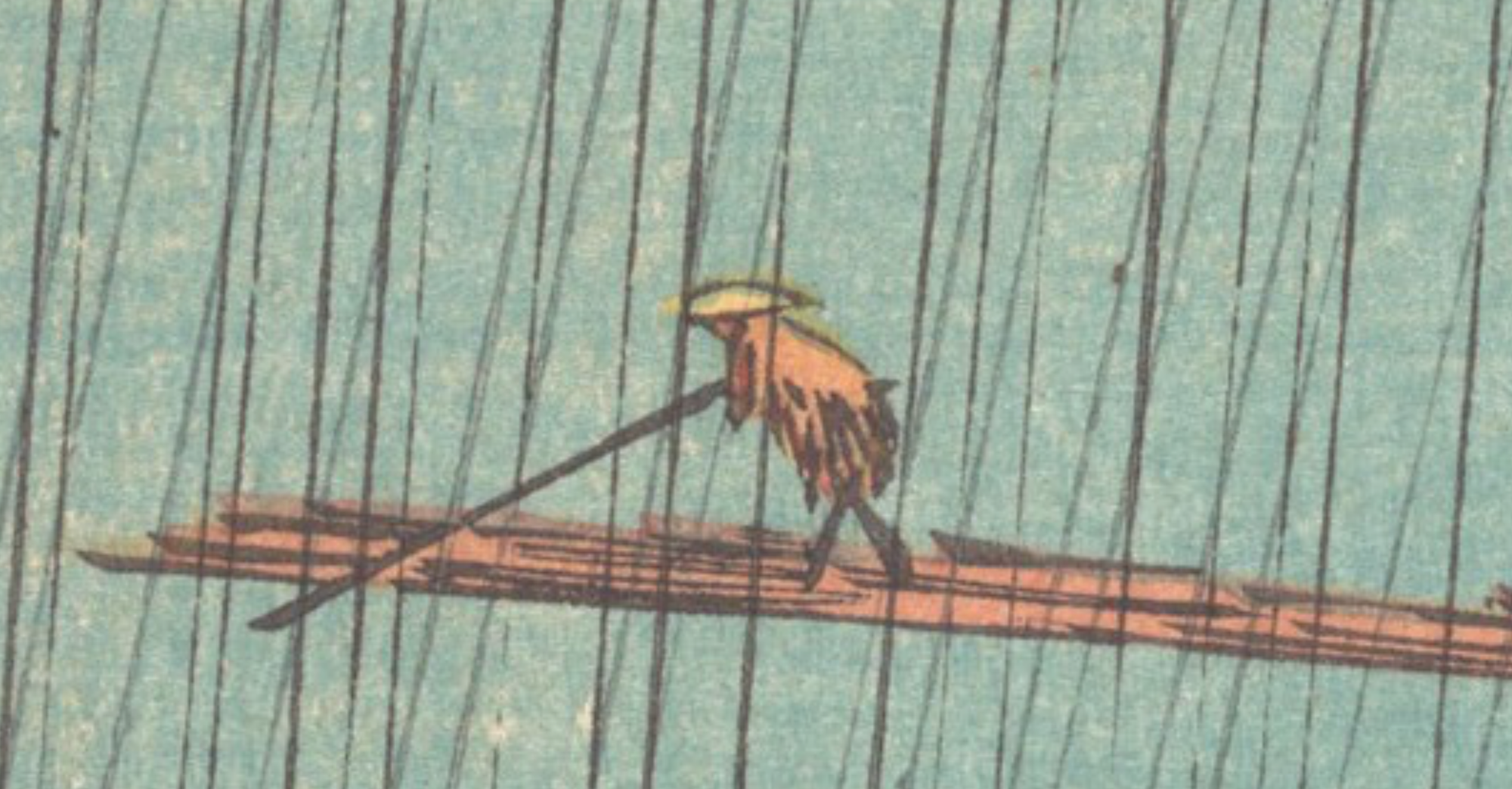
A lone boatman poles his raft down a grey-blue river, while the rain falls so hard it nearly wipes out the far bank. Which print is this, and who made it?
Hint: a Dutch painter owned this print and copied it in oil in 1887.
Last Sundays answer: The Great Wave, yes a very easy one, it will get harder each issue!
Presented by JPNStudio: Write with us
Do you love Japanese art, history or culture enough to dig into a topic and turn it into a story? We are building a crew of contributors for jpnstudio.com: researchers, writers and creators of every kind. You get full credit for your work, an audience of almost a million people across our channels. Tell us what you would write about: hello@jpnstudio2023.com
Community Gallery
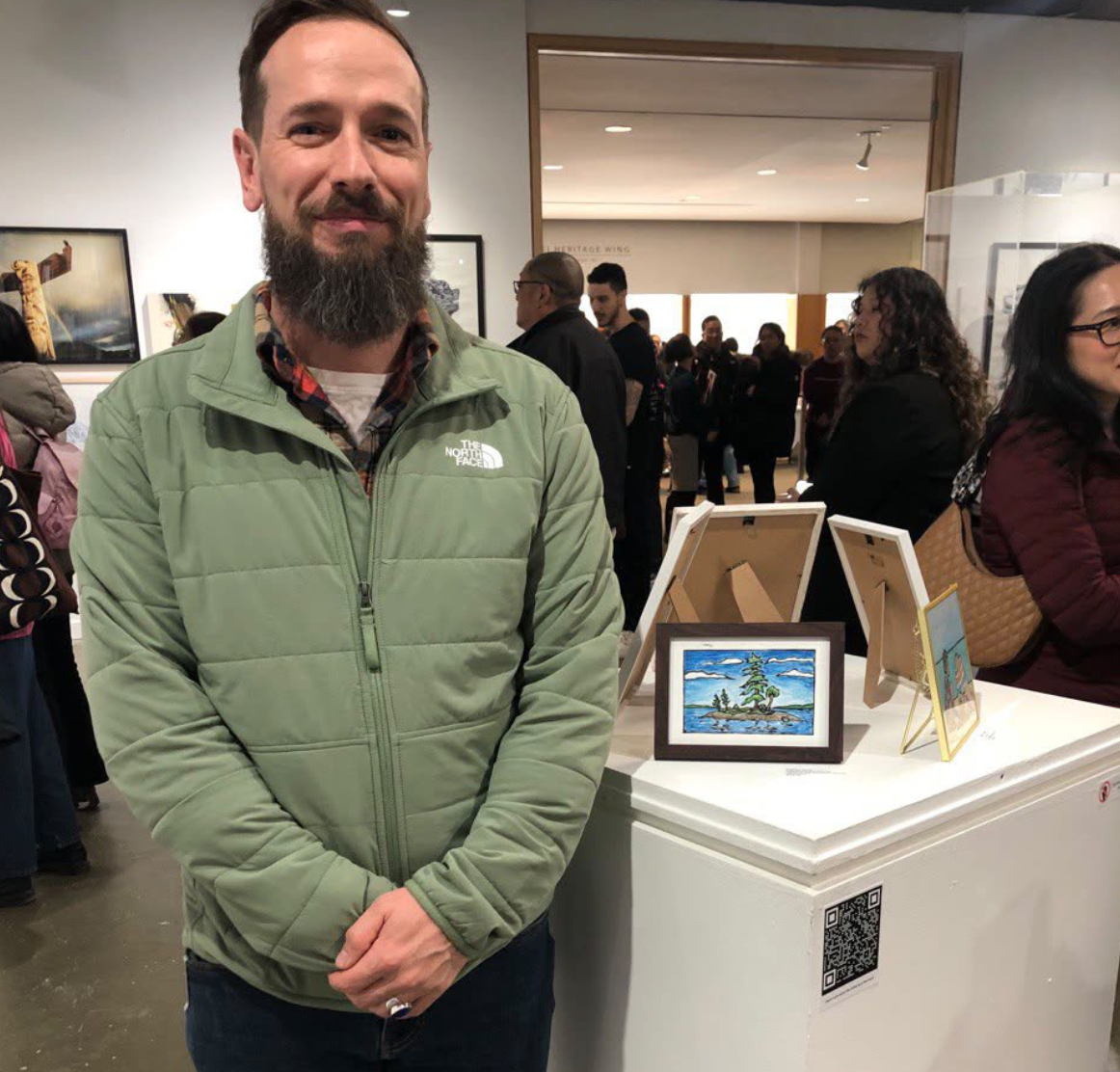
Steve North, @alpha_stevenorth
This was a block print I did last year. It had a three month residency at the (Japanese Canadian Culture Centre) JCCC In Toronto. I was inspired by the beautiful Canadian landscape by my wife’s family cottage in southern Ontario.
Want to be featured? Painting, prints, photography, ceramics, calligraphy, illustration and crafts are all welcome. Submit your work through instagram or Facebook message or directly reply to this email with your artwork.
Before You Go
Tote bag giveaway: help me shape The Floating World. What have you liked so far, what didn't you like, and what would you love to see more of? Leave a comment on this issue or simply reply to this email. Everyone who comments is in the draw for a JPN Studio tote bag. Last week's tote bag went to a reader in Canada: congratulations!
Share The Floating World: know someone who would love this? Forward this email, or share it with them however you like. New readers can sign up at jpnstudio.com.
Next week: a new masterpiece up close. I am keeping it a surprise for now.
See you next Sunday,
Bjorn